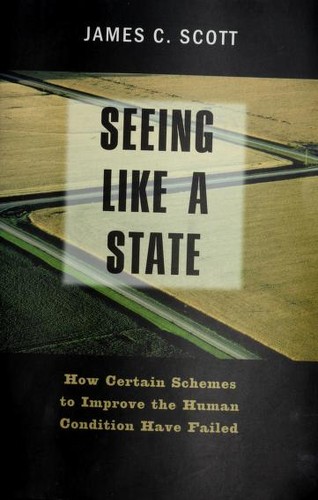
James Scott opens with scientific forestry in Prussia, foresters replanting messy old-growth woods into neat, single-species rows because a uniform grid is so much easier to tax and measure than an actual forest is, and from that one small case he builds out to the much bigger question the whole book is chasing: why do large-scale utopian schemes, the kind states love to run, keep failing in basically the same way, over and over, in totally different countries and centuries.
His answer, roughly, is that state administration needs a certain kind of legibility to function at scale, and the abstraction required to make a population “legible” strips out exactly the local, uncodified knowledge that actually makes complex systems work. The forest planted in a neat grid dies faster than the messy one because the mess was doing invisible ecological labor nobody accounted for. Same failure mode, he argues, shows up in Soviet collectivization, in high-modernist city planning, in villagization schemes, wherever someone with a blueprint and enough power decides the local, illegible way of doing things should be simplified for their convenience.
It’s a socioethnographic argument for humility, basically, a case for local, uncodified knowledge over reductionist central planning, and there’s a real Taleb-adjacent quality to it minus Taleb’s ego, if that comparison lands for anyone else who’s read both. Dense in stretches, and honestly the argument gets stretched a bit thin across so many examples that some chapters feel like the same point restated with new geography rather than new evidence.
Still one of the better academic reads I’ve gotten through in a while, genuinely entertaining in places despite being exactly the kind of book that sounds like homework. If you’ve ever wondered why so many well-intentioned top-down plans go sideways in the same specific way, this traces that pattern more convincingly than anything else I’ve read on the subject.